About the Journal
Open Access Policy
The International Journal of AYUSH (IJAYUSH) is a fully open-access, peer-reviewed scholarly journal. All scholarly articles published by IJAYUSH are immediately and freely accessible online to all users worldwide, without subscription, registration, payment, or embargo. The journal follows an open-access model in which the copyright holder grants users the right to access and reuse published scholarly content under the terms of the Creative Commons licence specified on each published article.
Users are permitted, in accordance with the applicable Creative Commons licence, to read, download, copy, distribute, print, search, link to the full text of articles, and otherwise use the published content for lawful purposes, subject to the terms and conditions of the applicable licence.
There are no access restrictions or embargo periods for published scholarly articles. The full text of every article is made available immediately upon publication through the journal website. IJAYUSH is committed to ensuring the widest possible dissemination and reuse of scholarly research and to removing both price and unnecessary permission barriers to access to published research.
The applicable Creative Commons licence and copyright information are clearly identified on the article landing page and within the published full-text article.
Copyright and Licensing
Copyright and licensing terms for published articles are clearly stated on the journal website and on each published article.
Unless otherwise stated on an individual article, authors retain copyright of their work and grant the journal the right of first publication. Published articles are distributed under the Creative Commons Attribution (CC BY) licence, which permits use, sharing, adaptation, distribution, and reproduction in any medium, provided that appropriate credit is given to the original author(s) and source and any changes are indicated.
The applicable Creative Commons licence governs the permitted use and reuse of each published article.
Peer Review Policy
The International Journal of AYUSH (IJAYUSH) follows a double-anonymous peer-review process for scholarly research articles.
All submitted manuscripts are initially evaluated by the Editorial Office for conformity with the journal's scope, basic scholarly requirements, ethical standards, and submission guidelines. Manuscripts that meet the preliminary requirements are forwarded for external peer review.
Each manuscript considered for publication is normally evaluated by at least two independent reviewers with relevant subject expertise. Reviewers are selected based on their academic or professional expertise and are independent of the authors and the journal's editorial decision-making process.
Under the double-anonymous review system, the identities of the authors are not disclosed to the reviewers, and the identities of the reviewers are not disclosed to the authors during the peer-review process. Reviewers are expected to maintain confidentiality and to declare any potential conflict of interest before undertaking a review.
Reviewers assess manuscripts on the basis of factors including, where applicable, originality, scientific or scholarly significance, methodological soundness, ethical compliance, clarity of presentation, validity of conclusions, adequacy of references, and relevance to the scope of the journal.
Based on the reviewers' reports, the Editor or designated Editorial Board member makes the final editorial decision. Possible decisions include acceptance, minor revision, major revision, or rejection. The journal may request additional review where reviewer reports are substantially divergent, where specialist expertise is required, or where further assessment is necessary to reach a fair editorial decision.
The peer-review process is applied before publication to ensure that scholarly articles undergo appropriate independent academic evaluation. Any exceptions to the standard peer-review process, including the handling of editorials, letters, invited articles, or other non-research content, are identified according to the article type.
The journal does not guarantee acceptance or a specific publication time for submitted manuscripts. Editorial decisions are based on the scholarly merits of the manuscript and are not influenced by the authors' nationality, institutional affiliation, gender, religion, or other non-scholarly characteristics.
Aims and Scope
Aim
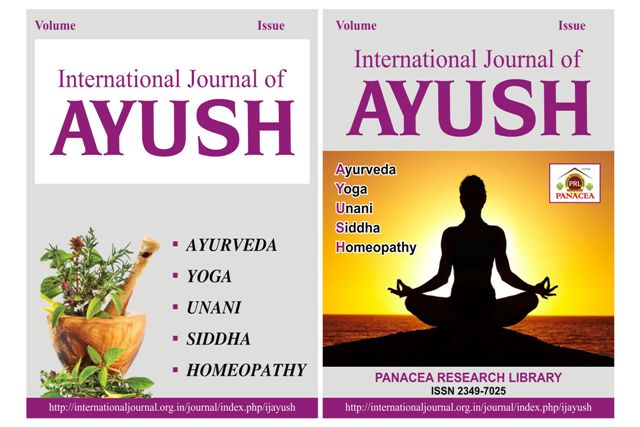
The International Journal of AYUSH (IJAYUSH) aims to provide an international, peer-reviewed, open-access platform for the publication and dissemination of high-quality scholarly research in Ayurveda, Yoga, Unani, Siddha, Homeopathy, Sowa-Rigpa, and related traditional, complementary, and integrative health sciences.
The journal seeks to promote rigorous scientific inquiry, interdisciplinary collaboration, and responsible scholarly communication concerning traditional healthcare systems and their contemporary applications. IJAYUSH welcomes research that contributes to the understanding, evaluation, documentation, development, and responsible integration of AYUSH knowledge and practices within healthcare, education, and public health.
Scope
IJAYUSH welcomes original research articles, review articles, systematic reviews, scoping reviews, meta-analyses, case reports and case series, short communications, methodological studies, and other scholarly contributions relevant to the journal's aims.
The scope includes, but is not limited to:
Ayurveda: Kaya Chikitsa, Shalya Tantra, Shalakya Tantra, Kaumarbhritya, Agada Tantra, Rasashastra and Bhaishajya Kalpana, Dravyaguna, Rasayana, Vajikarana, Panchakarma, Swasthavritta, Ayurvedic pharmaceutics, pharmacognosy, medicinal plants, traditional therapeutics, and related areas.
Yoga: Hatha Yoga, Raja Yoga, Ashtanga Yoga, Kundalini Yoga, Kriya Yoga, meditation, pranayama, yoga therapy, preventive healthcare, rehabilitation, mental and physical well-being, and clinical, experimental, and interdisciplinary research related to Yoga.
Unani: Ilaj-bit-Tadbeer, Ilaj-bit-Ghiza, Ilaj-bit-Dawa, pharmacology, clinical research, regimenal therapy, preventive medicine, pharmacognosy, traditional therapeutics, and allied Unani medical sciences.
Siddha: Fundamental principles of Siddha medicine, Siddha pharmacology, clinical medicine, Varmam, traditional therapeutics, Yoga therapy, medicinal substances, preventive healthcare, and allied disciplines.
Homeopathy: Organon of Medicine, Homoeopathic Philosophy, Materia Medica, Repertory, Homoeopathic Pharmacy, clinical practice, community medicine, pediatrics, psychiatry, obstetrics and gynaecology, surgery, preventive healthcare, and relevant basic and clinical sciences.
Sowa-Rigpa and Traditional Medicine: Sowa-Rigpa, Tibetan medicine, traditional pharmacopoeias, ethnomedicine, medicinal plants, traditional knowledge, traditional healthcare practices, and related fields.
Interdisciplinary and Integrative Health Research: Public health, preventive healthcare, pharmacology, pharmacognosy, drug standardization, medicinal plants, clinical research, healthcare education, epidemiology, health promotion, traditional knowledge, integrative medicine, and interdisciplinary approaches to traditional and contemporary healthcare.
The journal particularly welcomes evidence-informed and methodologically rigorous research that advances scientific understanding of AYUSH systems, evaluates traditional healthcare practices and products, contributes to the responsible preservation and documentation of traditional knowledge, or explores relevant applications in contemporary healthcare and public health.
IJAYUSH encourages interdisciplinary and international contributions that foster meaningful academic dialogue across traditional medicine, complementary and integrative health sciences, biomedical sciences, pharmacy, nursing, public health, and related disciplines.
Digital Archiving and Preservation
The International Journal of AYUSH (IJAYUSH) preserves its published scholarly content through Zenodo, an open-access research repository operated by CERN. Published articles and associated scholarly records deposited in Zenodo are assigned persistent identifiers and are intended to remain accessible for long-term scholarly reference and preservation.
The journal is committed to maintaining access to its published content and to supporting the long-term availability and discoverability of its scholarly record.
Repository and Self-Archiving Policy
The International Journal of AYUSH (IJAYUSH) permits authors to deposit and make available versions of their published work in institutional repositories, subject-based repositories, and other non-commercial scholarly repositories of their choice, subject to applicable copyright and licensing terms.
Authors may deposit the published version (Version of Record) of their article immediately after publication, provided that the deposited copy retains the original bibliographic information, DOI, citation details, and a link to the official article on the IJAYUSH website.
Authors are encouraged to use institutional or recognized subject repositories to increase the discoverability, accessibility, and long-term availability of their research.
The journal does not impose an embargo period on the repository deposit of articles published under its applicable open-access licence.
Authors should ensure that any deposited version accurately reflects the final published article and includes appropriate attribution to the International Journal of AYUSH (IJAYUSH) and the original publication.
Plagiarism Policy
The International Journal of AYUSH (IJAYUSH) is committed to maintaining high standards of academic integrity and publication ethics. The journal does not accept plagiarism, duplicate publication, redundant publication, or substantial unattributed use of previously published material.
Plagiarism Screening
All submitted manuscripts are routinely screened for plagiarism and text similarity during the editorial evaluation process. The journal uses the Quetext Plagiarism Checker to assist in identifying textual similarities and potentially unoriginal or duplicated content.
Plagiarism screening may be conducted at the initial editorial assessment stage and, where necessary, at subsequent stages of peer review and production.
Evaluation of Similarity
A similarity report is not assessed solely on the basis of a particular similarity percentage. The Editorial Office considers the nature, extent, location, and sources of the identified similarities. Legitimate similarities, including properly cited quotations, references, standard terminology, commonly used methodological descriptions, and other appropriately attributed material, may not constitute plagiarism.
Where substantial or inappropriate similarity is identified, the Editorial Office may request clarification or revision from the authors. Depending on the nature and extent of the concern, the manuscript may be returned to the authors, subjected to further editorial investigation, rejected, or handled in accordance with applicable publication-ethics principles.
Duplicate and Redundant Publication
Manuscripts that substantially reproduce previously published work, including duplicate or redundant publications, without appropriate disclosure and justification may be rejected. Authors are responsible for informing the journal about any closely related manuscripts or previously published material that could overlap substantially with their submission.
Post-Publication Concerns
If plagiarism, substantial unattributed duplication, or other forms of academic misconduct are identified after publication, the journal may investigate the matter and take appropriate corrective action. Depending on the circumstances, such action may include publication of a correction, expression of concern, or retraction of the article.
Author Responsibility
Authors are responsible for ensuring that their submitted work is original, that all sources are appropriately acknowledged, and that quotations, adaptations, previously published material, and the contributions of other authors are properly cited and attributed.
Plagiarism screening is an important component of the journal's editorial quality-control process. It does not replace editorial assessment or independent peer review.